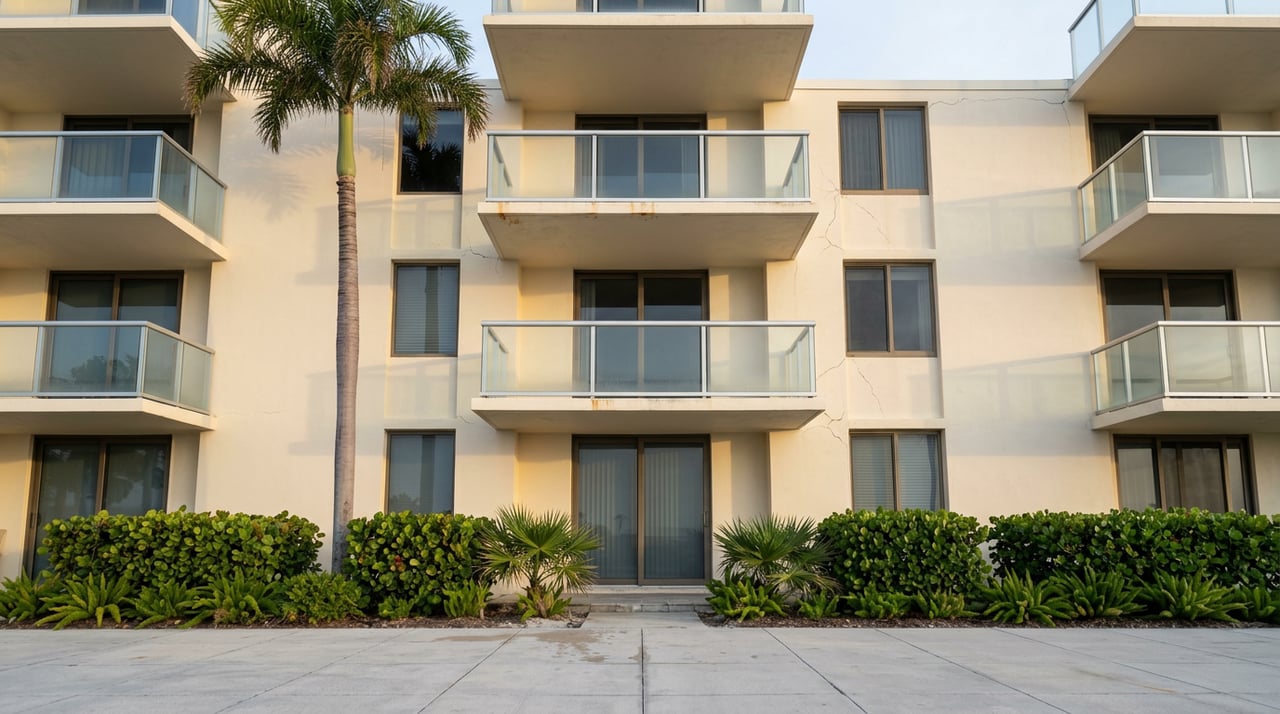
What if the monthly HOA fee—the number every condo buyer is trained to like—doesn't tell the whole story?
That's the question worth sitting with before you tour another oceanfront unit in Surfside. For years, a modest monthly fee on an older building read as good news: a well-run association, careful budgeting, no waste. In 2026, on a Surfside condo built before 1990, that same number may warrant a closer look. It may reflect reserves that have not kept pace with repairs, and some costs may be addressed through a special assessment.
The Champlain Towers South collapse in June 2021 killed 98 people in a 12-story beachfront building. The engineering failures had been documented years before. The money to fix them had not been raised. Every state law that now governs how Florida condos inspect themselves and save for repairs traces back to that building, on that street, in that town. If you are buying here, you are buying inside the origin story of the regulation, not just the destination.
Two Recertification Clocks, Not One
Buyers often assume Florida's post-Surfside laws, the milestone inspection and the Structural Integrity Reserve Study, are the whole compliance picture. In Surfside, they are only half of it.
The International Code Council reports that Miami-Dade County has required buildings to recertify their structural and electrical systems since 1975, after a different building partially collapsed and killed seven people. That county program originally applied to any building over 2,000 square feet regardless of height, historically kicking in around the 40-year mark, and it still runs independently of the newer state statute. When local building officials in coastal Miami-Dade require inspection at 25 years instead of 30, they're leaning on authority that predates Champlain Towers South by nearly half a century.
So a Surfside building can be current on its state-mandated milestone inspection and still have county-level recertification obligations layered on top, on a different clock, with different paperwork. Ask which one applies, and ask for both files. A seller who can only produce one is not necessarily hiding something, but they haven't finished answering the question.
What a Low HOA Fee May Signal
Here is the mechanism worth understanding when you assess a listing's low carrying cost.
For decades, Florida condo boards could vote to waive reserve contributions, which kept monthly dues low even on buildings with aging roofs, corroding rebar, and deferred concrete work. According to Florida's DBPR, as of January 1, 2026, that option is gone for the structural items covered by a SIRS. Associations can no longer vote their way out of saving for the eight statutory categories, including the roof, the load-bearing structure, plumbing, electrical, fireproofing, waterproofing, and exterior doors and windows.
That change makes a low fee a reason to look more closely at reserves. A building that has been funding reserves for years will often show a higher monthly number, because it has been paying the real cost of ownership the whole time. A comparatively low fee on an older Surfside tower is a reason to check whether reserves have caught up with repair needs. If they haven't, the catch-up may arrive as a special assessment, frequently in the tens of thousands of dollars per unit and sometimes far higher on buildings with significant deferred concrete or waterproofing work.
| What buyers used to read | What it actually signals in 2026 |
|---|---|
| Low monthly HOA fee | Reserves may not yet reflect the SIRS-mandated funding schedule |
| No recent special assessment | Repair costs may still be sitting in a Phase 2 report awaiting a board vote |
| Building "looks" well maintained | Cosmetic condition and structural condition are evaluated separately, and only one shows in photos |
| Older building, lower price per square foot | Older buildings are the ones most likely mid-catch-up on decades of underfunding |
What the State's Own Numbers Confirm
The Florida Legislature's watchdog office, the Office of Program Policy Analysis and Government Accountability, released the state's first statewide look at how this compliance push is actually going on August 1, 2026. Building officials reported that 8,736 condo buildings had completed Phase 1 milestone inspections and 1,575 had gone on to the more invasive Phase 2, with nearly 1,600 deadline extensions granted, 94 percent of them to buildings in coastal municipalities concentrated in Miami-Dade, Broward, and Palm Beach counties, according to reporting from The Real Deal.
The part of that report worth sitting with as a buyer: 30 buildings in 2024 and 24 in 2025 were found unsafe or uninhabitable, and most were not actually vacated. Compliance on paper and safety in practice are not the same finding, and a designation that sounds catastrophic doesn't automatically force the outcome you'd expect. That cuts both ways for due diligence. It means you can't assume a building's continued occupancy is proof that its structural condition is fine. It means the paper trail, the actual inspection report and the actual reserve study, carries more information than the fact that people are still living there.
Surfside's Grant Program and What It Covers
The Town of Surfside says its Building Recertification Permit Fee Assistance Grant Program, approved in 2026, offers eligible condominium buildings up to $200,000 per recertification cycle toward municipal permit fees, including structural and electrical review fees. It's a genuinely useful program for eligible buildings.
Read the fine print before you count on it as a buyer, though. The grant covers permit fees. It does not cover engineering studies, construction, repairs, or legal costs, which are the categories that actually drive a six-figure special assessment. A building tapping this grant has solved a paperwork-fee problem, not necessarily a structural-funding one.
What to Request Before You Write an Offer
On any Surfside building built before 1990, ask for these documents before you go under contract, not after:
- The completed milestone inspection report, and if a Phase 2 was triggered, the remediation plan and the building official's response to it
- The current Structural Integrity Reserve Study, showing the funding status of all eight statutory categories, not just a summary page
- Board meeting minutes from the past 24 months, specifically any discussion of special assessments, loans, or lines of credit taken against future reserves
- The current operating budget, compared against the SIRS-recommended funding schedule
- The estoppel certificate, cross-referenced against everything above, since it only captures a point-in-time snapshot and won't tell you what's being discussed in the boardroom right now
If a building can't produce a current SIRS, that also affects your financing. Buildings flagged for incomplete inspections, insufficient reserves, or unresolved deferred maintenance can land on lender restricted lists, which narrows your options to portfolio or non-QM loans at different terms than a standard conventional mortgage, even if you were planning to finance conservatively.
FAQ
Does a newly built Surfside condo need to worry about any of this? The SIRS requirement is triggered by height, three or more habitable stories, not age, so even a recently completed building needs one on file. The milestone inspection age trigger, 25 or 30 years, won't apply to new construction for decades.
If I'm paying cash, do I still need to care about lender eligibility? Yes. Even an all-cash buyer benefits from a building that a future buyer can finance conventionally, since restricted lender status shrinks the resale pool and can affect what the market is willing to pay when you eventually sell.
Is Surfside worse off than other Miami-Dade coastal towns? Not necessarily. Surfside faces the same layered county and state requirements as Bal Harbour, Sunny Isles Beach, and Miami Beach. What sets it apart is its connection to Champlain Towers South, the collapse that prompted these laws. Surfside also has its own grant program, which eligible buildings may use toward permit fees. Those details make due diligence here especially central to the purchase.
The unit's finishes tell you what the seller wants you to see. The SIRS and the board minutes tell you what the building actually is. In Surfside, that second file is where the real negotiation starts.
If you're evaluating a specific building here and want a second set of eyes on its reserve study before you write an offer, The Cofresi Group works these buildings closely enough to know which questions get real answers. Receive Exclusive Listings and start with the paperwork, not just the view.
This article is general information, not legal, tax or financial advice. Consult a qualified professional about your situation.