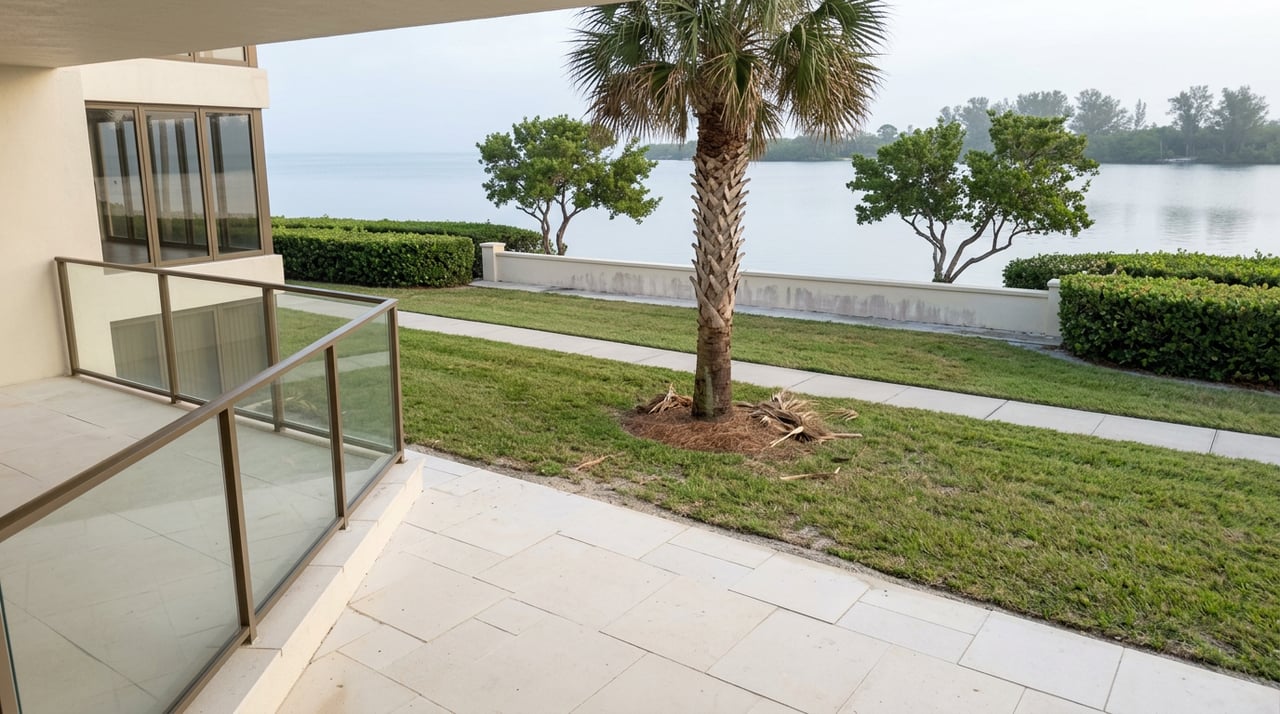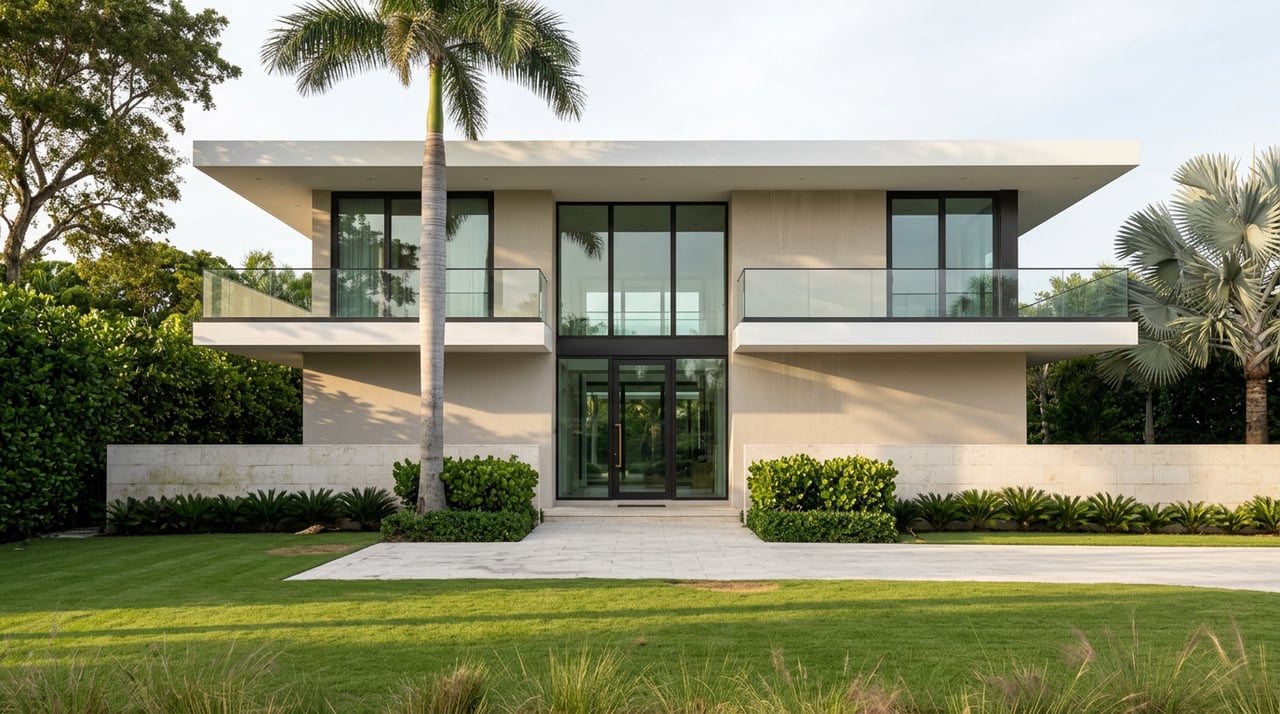
On July 29, 2026, a 0.6-acre oceanfront lot at 625 Ocean Boulevard traded for $24 million. An entity led by Amicus Medical Group president David Rodriguez bought the parcel, financed with a mortgage from New Wave Loans; the deal worked out to about $860 per square foot, and the buyer plans to build a spec home on the site, which includes 100 feet of ocean frontage. The previous owners, the Herricks, had held the property since 1986, when they paid $841,500 for it.
Read that sale carefully. The buyer is not paying for a house. There is no house on the deal that matters. The buyer is paying for a rectangle of sand between A1A and the Atlantic, and everything else in Golden Beach pricing follows from that fact.
The comp problem most buyers walk into
The reader who arrives here from the public portals has already seen a median in the seven-million-dollar range and assumed it behaves like any other luxury benchmark. It does not. Price per square foot of finished home is close to meaningless here — completed homes range from approximately $800 to nearly $3,800 per square foot depending on whether a buyer values the structure or intends to demolish it, and the honest, auditable unit of value in Golden Beach is the square foot of land, verifiable against county lot sizes.
That range is not a data anomaly. It is the whole thesis in one number.
| What the buyer is paying for | Effective $/sf on finished home |
|---|---|
| The land, structure treated as scrape value | ~$800 |
| A modern, elevated, architecturally current home | Toward $3,800 |
The same street, the same ocean, the same setback. What moves the ratio is whether the existing structure survives the next closing or gets hauled to a landfill. In practice, that turns every listing into two separate underwriting exercises, and mixing them is the single most common way buyers overpay or sellers stall.
The Rodriguez pattern, decoded
David and Lorena Rodriguez are not new to this thesis. The couple paid $29 million for a 35,000-square-foot lot at 401 Ocean Boulevard in 2023, which includes 125 feet of private beach, and they also own a property at 125 Ocean Boulevard, which they bought for $7.2 million in 2020, with plans for an eight-bedroom, 10-bathroom home spanning over 14,000 square feet nearing full approval. Their broker has said Rodriguez is heavily invested in Golden Beach because he believes it is "undervalued."
Notice what is being accumulated: frontage and lot size, not existing improvements. Two of the three parcels are under construction. The 625 Ocean sale extends the same logic to a third address in the same corridor. When a repeat buyer of this caliber concentrates on land units on one barrier island, the market is telling you what it prices.
Why 22 months of supply is the product, not a warning
A buyer accustomed to Miami Beach or Brickell absorption rates will look at Golden Beach's inventory and assume a soft market. That reading misses the mechanism.
Against a balanced market of roughly six months of supply, Golden Beach carries approximately 22 months overall, and oceanfront alone sits near 27 months with a median time-to-sell of 689 days — nearly two years. The reason is structural, not sentimental. The town cites 364 single-family homes, a structural cap that limits supply over time — there is no condo tower pipeline to widen choice sets, and no mixed-use phases that gradually deliver new product.
A fixed-seat market with fewer than 400 chairs cannot absorb like a market where the developer down the block can add 200 units next quarter. Sellers here are not competing with new supply. They are competing with the next patient buyer's timing.
When a Golden Beach listing does stall past the two-year mark, the cause is almost always one of three specific frictions:
- A land basis priced against the wrong comp set. The seller anchored to finished-home $/sf when the buyer is running land-$/sf math.
- An unresolved elevation and insurance picture. Florida flood premiums in the highest-risk coastal zones range from a few thousand to well over ten thousand dollars annually, and federal coverage is capped far below a luxury home's replacement cost, so a current elevation certificate and a clear, quantified insurance picture are selling tools, not paperwork.
- Public listing when the deal was always going to close off-market. The most significant Golden Beach trades never touch a public portal, which means a listing that leans on portal exposure alone is fishing in the wrong pond.
The underwriting sequence, in order
For a serious buyer or a serious seller, the sequence is unusual enough to be worth stating plainly.
- Pull the county lot dimensions before you look at photos of the kitchen. Frontage and square footage of land are the two numbers on which the offer rests.
- Ask for the elevation certificate and a current flood insurance quote. In the highest-risk coastal zones, that quote is a line item that survives the closing, and it belongs in the underwriting from day one.
- Confirm the seller's real basis. A lot bought decades ago at pre-boom pricing behaves differently in negotiation than one traded near current comps. The Herrick parcel had a 1986 basis of $841,500 and closed at $24 million; the seller's expectations were shaped by a very different cost structure than a 2023 buyer's would be.
- Assume the meaningful inventory is off-market. A brokered relationship, not a portal search, is how the useful shortlist gets built.
Governance as a form of underwriting
The final piece a buyer often underweights is the town itself.
Golden Beach is led by an elected Mayor and four Council Members who serve two-year terms, with a Town Manager appointed by the Council, and a defining feature for a town of its size is that Golden Beach operates its own municipal Police Department. The town's charter and zoning are structured to prohibit commercial development, a deliberate choice that keeps the streetscape focused on private residences rather than retail strips, nightlife, or hotel density. The town's civic infrastructure has also been getting reinvested in at a scale most 1.6-mile municipalities cannot match: Florida Trend reported that the new Civic Center, town hall and Landfall Team Bunker cost $7 million, part of a city-wide, $67 million capital improvement effort that reflects the growing needs for a city whose assessed value of its 380 homes has risen from $500 million almost two decades ago to $1.7 billion today.
A 3.4x rise in assessed base over roughly two decades, on a fixed-seat inventory, is what a land thesis looks like on the municipal balance sheet.
What the shape of the beach itself is worth
One last piece of the pricing puzzle sits at the sand line. The Atlantic beach in Golden Beach is reserved exclusively for town residents and their guests — it is not a public beach, not a hotel beach, and not accessible through any public path; it is accessed via the town's own beach pavilion, and this is one of only a handful of communities on the Eastern Seaboard with a genuinely private residential beach.
That is a scarcity input the portals do not carry as a data field. It shows up only in what buyers are willing to pay per square foot of dirt. It also explains why high-rise construction and commercial development are not permitted within the town limits, and A1A continues to be the only road into town, with a police guardhouse at the community entrance — the scarcity is protected by law, not by convention.
FAQ
If oceanfront takes nearly two years to sell, is now a bad time to list? No. The 27-month oceanfront figure is a supply function, not a demand signal. The remedy is a defensible land-$/sf basis, a clean elevation and insurance file, and a marketing plan that assumes the buyer arrives through relationships as often as through search.
How should a buyer think about scraping an existing home? As a legitimate strategy at the low end of the $800-to-$3,800 range. If the structure adds no value to a buyer, the offer is a land offer, and the demolition cost is a below-the-line expense, not a negotiation lever.
What actually justifies frontage premiums? Frontage is the only lot dimension that cannot be manufactured. Interior square footage can be reconfigured; setbacks can be studied; frontage is fixed the day the plat was drawn. Two lots of identical square footage with different frontage widths are two different assets.
Is the town's private beach access transferable with a sale? It runs with residency in Golden Beach, which is what a home purchase confers. The pavilion access is one of the reasons a Golden Beach basis is not directly comparable to an oceanfront home one town over.
For a private, building-by-building read on where Golden Beach land is trading right now, and where the off-market inventory sits, The Cofresi Group works discreetly with buyers and sellers who want the underwriting done before the offer, not after. Receive Exclusive Listings by reaching out directly.